

The Reason You Can’t Unlock India’s Real Potential – Has Nothing to Do With India
Table of Content
- Introduction
- The Myth That Is Costing You Millions in Potential Margin
- Inside the Factory Owner's Mind: The 8 Questions That Determine If You'll Ever Hear Back
- Why This Problem Is Unique to India - and Why China Taught You the Wrong Lessons
- The Real Maths: What "Saving the Commission" Actually Costs You
- The Five Things a Buying Agency Unlocks That You Simply Cannot Access Alone
- Why the Factory Trusts the Buying Agency - The Psychology of Ongoing Business
- A Real Story: The Buyer Who Spent Two Years Going Direct
- How to Know If a Buying Agency Is the Right Fit for Your Programme
- The Commission Isn't the Price of Access. It's the Price of Everything.
Introduction
You conclude that India is “difficult to work with.” You go back to your Chinese supplier. India remains locked.
This story isn’t rare. It’s the norm. And the reason it keeps happening isn’t what most buyers think.
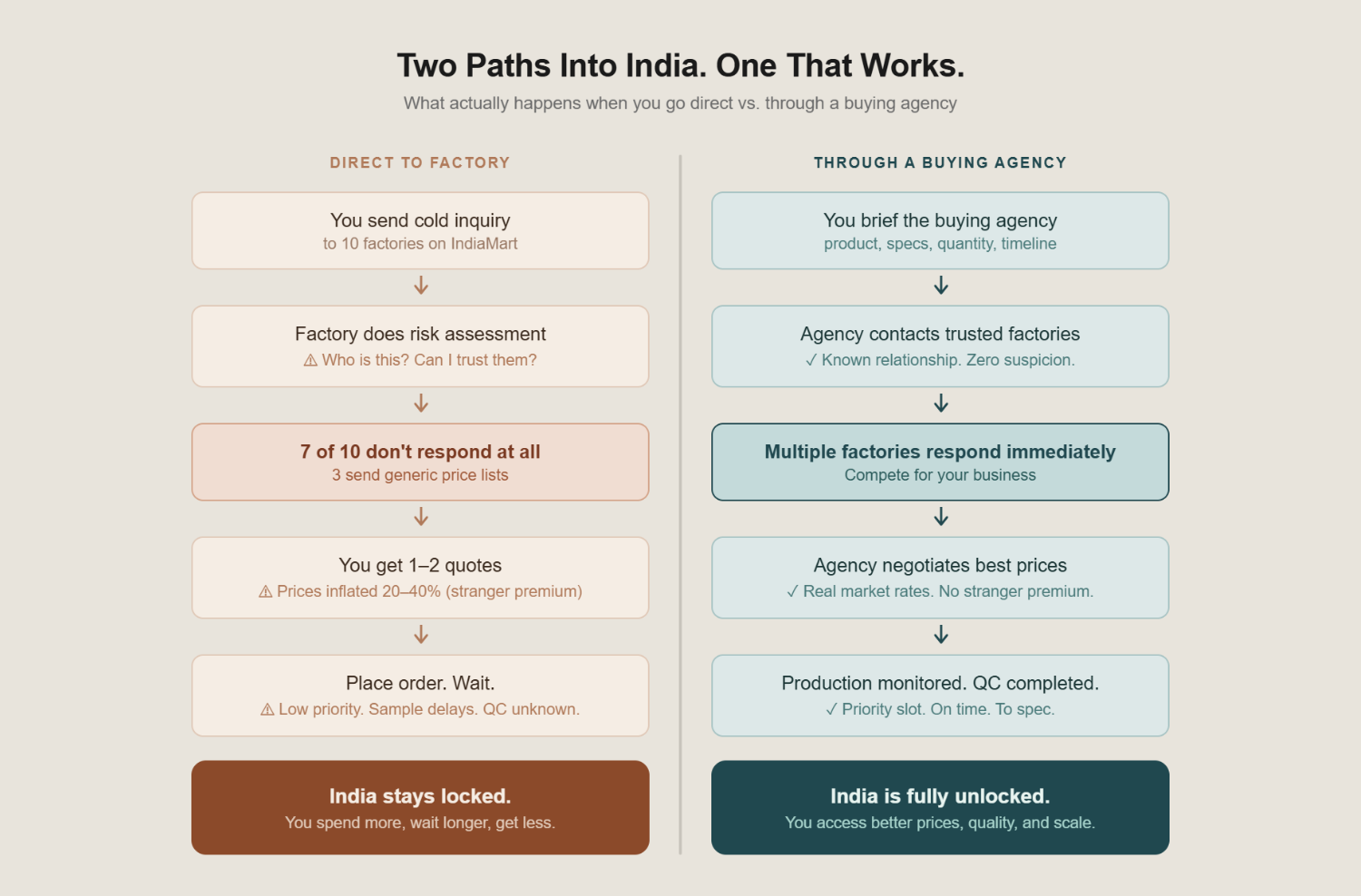
Here's what's actually happening on the other end of your email.
He has no way to tell which of the 30 is which. So his default answer – the rational, self-preserving answer – is silence, or a non-committal “please share more details” that most buyers interpret as disinterest.
You’re not being rejected. You’re being risk-filtered.
The Myth That Is Costing You Millions in Potential Margin
There is a belief held by almost every importer who hasn’t yet built a serious India sourcing programme. It sounds entirely reasonable. It goes like this:
Let’s dismantle it – not with theory, but with how India’s manufacturing supply chain actually functions.
20-30
<4%
74
7M+
Inside the Factory Owner's Mind: The 8 Questions That Determine If You'll Ever Hear Back
When your cold inquiry lands in an Indian factory’s inbox, it triggers an instinctive but very logical risk assessment. Not a formal one – an unconscious one, built from years of experience with buyers who never converted. Understanding this mental checklist is the key to understanding why India sourcing works the way it does.
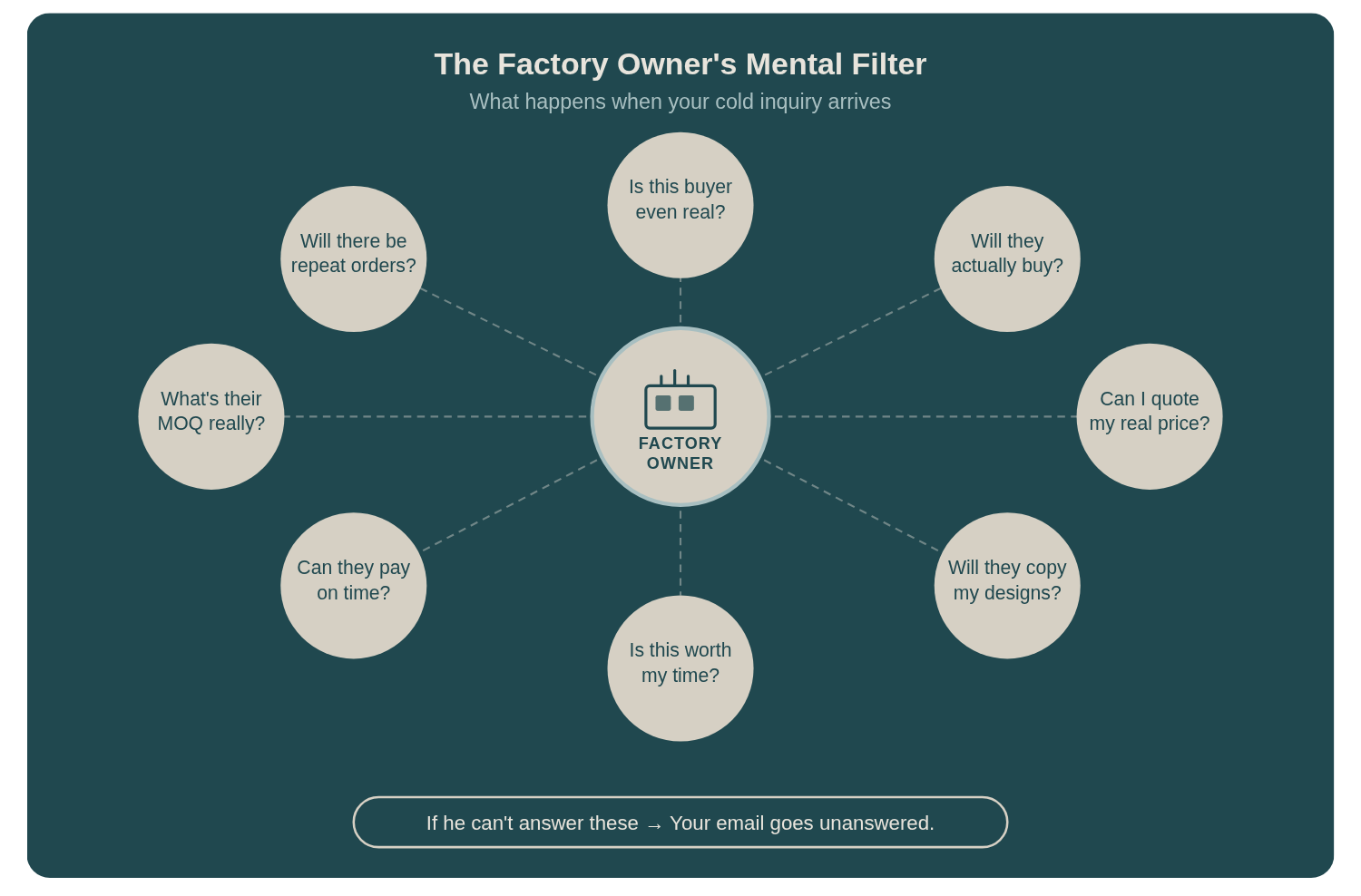
The factory owner is not being rude. He is being rational. He runs a business. Every hour he spends preparing a sample quote, pulling specifications, and managing communication is an hour not spent on production for buyers he already knows and trusts. The invisible cost of responding to unqualified inquiries is enormous – and Indian factory owners have learned, through painful experience, to guard against it.

The Genuineness Question
A significant proportion of “inquiries” Indian factories receive are not from real buyers. They are from competitors benchmarking prices, from market researchers, from students writing theses, or from people exploring “what sourcing from India costs” with no actual buying intent. Factories have learned this. Without evidence of genuineness – a company website, a track record, a prior relationship, a mutual connection – you start at zero credibility.

The Design Theft Fear
India has experienced real IP theft – overseas buyers who request samples, take detailed photos of the designs, and then have them replicated by factories in China or Bangladesh. This fear is particularly acute in the handicraft and home decor sector, where designs are often the factory’s primary competitive asset. Sharing detailed design specifications with an unknown foreign buyer feels risky – and for good reason.

The Sample Investment Dilemma
Producing a sample for an artisan home decor product is not pressing a button. It requires skilled artisan time; often 2–5 days of a craftsperson’s work. For the factory, samples are a real investment. Producing samples for buyers who then disappear, or who use the sample price as leverage with a cheaper factory, is expensive. Without trust, the factory is reluctant to make this investment for a stranger.

The Inflated Quote Problem
When a factory doesn’t know a buyer, it doesn’t know their market awareness. So they quote defensively – higher than their best price, with large buffers for “unknown buyer risk.” This means that even when you do get a response, the price you receive is not India’s real price. It’s a price with a stranger-premium embedded. It might be 20–40% above what a buying agency with an established relationship would negotiate for the exact same product.

The Priority Allocation Problem
Even if you manage to break through and place an order, a factory with no established relationship with you will prioritise its known, loyal customers over you when capacity is tight. In India’s artisan sector, capacity is almost always tight before the major buying seasons. Your order will be at the back of the production queue, which means late delivery; the most common complaint from first-time India importers.
Why This Problem Is Unique to India and Why China Taught You the Wrong Lessons
This is because China’s export manufacturing ecosystem has been built, over 40 years, specifically to serve Western buyers. Trading companies, sourcing agents, and factory sales departments in China have all been optimised for the fast, transactional Western sourcing model. They’ve removed friction from the process because they had to – China’s manufacturing advantage depended on making it easy for Western buyers to access.
India’s handicraft and home decor manufacturing is dominated by small workshops and family businesses. The Export Promotion Council for Handicrafts (EPCH) estimates that over 85% of India’s artisan manufacturers employ fewer than 50 people. These are not corporations with polished sales departments and multilingual account managers. They are craftspeople who have turned their skills into businesses and who have learned to be deeply selective about which buyers they invest time and material in serving.
This isn’t a weakness of the Indian manufacturing ecosystem. It’s a structural characteristic that, once you understand it, becomes a profound advantage because the same selectivity that makes India hard to access for strangers makes it exceptionally rewarding for those who are known, trusted, and vouched for.
A buying agency is not a middleman. It is the trust infrastructure that makes the entire system work.
India’s artisan manufacturing ecosystem was not built to serve Western buyers efficiently. It was built to create extraordinary things and it is governed by relationships, trust, and community in ways that China’s industrial manufacturing simply is not.
The Real Maths: What "Saving the Commission" Actually Costs You
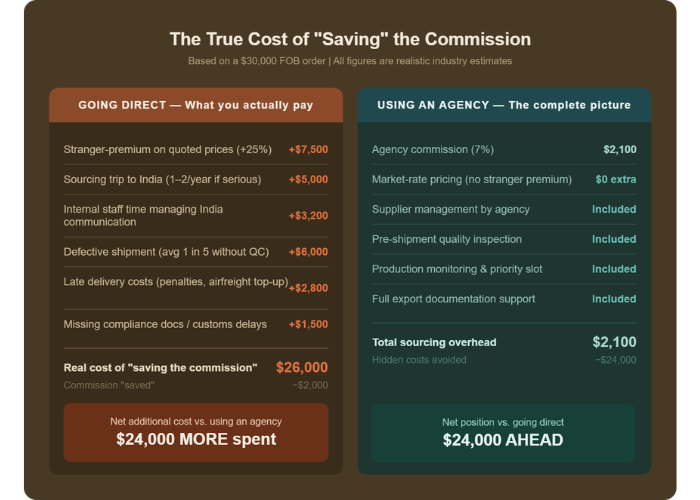
A professional India buying agency charges 5–8% on the FOB value of goods sourced. On a $30,000 order, that’s $1,500–$2,400. This is the number buyers fixate on. “I can save $2,000 by going direct.”
The commission isn’t a cost. It’s a return on investment with a measurable multiple. The buyer who “saves” $2,000 by avoiding an agency typically loses $24,000 in inflated prices, hidden inefficiencies, delayed delivery costs, and defective shipments. And that’s before counting the opportunity cost of the India sourcing programme that never actually got off the ground.
The Five Things a Buying Agency Unlocks That You Simply Cannot Access Alone
Beyond the economics, there are five strategic unlocks that a professional India buying agency provides that have no equivalent in direct sourcing at any price.
🔒
TRUST
UNLOCK 01
Factories respond immediately to known buying agencies. No credential check. No suspicion. No filter. Your enquiry goes straight to the front of the queue.
💰
REAL PRICE
UNLOCK 02
⭐
PRIORITY
UNLOCK 03
🛡️
QUALITY
UNLOCK 04
🌍
ALL OF INDIA
UNLOCK 05
Why the Factory Trusts the Buying Agency - The Psychology of Ongoing Business
A buying agency like Azoonis has been working with the same Moradabad brass workshop for years. That relationship means:
What the Factory Knows About a Trusted Buying Agency
→
They will bring multiple buyers, not just one – the factory’s investment in the relationship pays dividends across many orders
→
They understand the manufacturing process – they won’t ask for impossible timelines or specifications that aren’t feasible in the material
→
They will not copy designs or share proprietary techniques with competitors – they have a reputation and a business to protect
→
They have market knowledge – there’s no point inflating the quote, because the agency will know immediately if the price isn’t competitive
→
They will flag quality issues early – not after the container has shipped which protects the factory’s reputation as much as the buyer’s interest
→
Payment will be reliable – the agency manages the commercial relationship professionally, and the factory isn’t taking on unknown payment risk
Every one of these points is something a cold-calling foreign buyer cannot offer. And every one of them is a reason the factory gives the buying agency what it cannot give a stranger: its best price, its best quality, its priority slot, and its honest communication.
A Real Story: The Buyer Who Spent Two Years Going Direct
A European wholesale buyer begins sourcing from India independently. They find five factories on IndiaMart. They get three responses. They place two orders. The first arrives reasonably well – some quality issues, later than expected, but acceptable. They’re encouraged. The second order is a disaster – wrong finish, 15% damage rate, delivered six weeks late. They spend four months resolving claims. They conclude India is “inconsistent.”
They continue, because India’s products are genuinely beautiful and their customers love them. They keep finding new factories because the old ones either stop responding or start producing inconsistently. Each new factory relationship starts the trust-building process from zero. They never build the supplier depth that would give them access to India’s best prices. They never get priority treatment. They spend enormous amounts of internal time managing the chaos.
Then they engage a buying agency. In the first three months, they access eight new factories across four clusters. Their prices drop 18% on existing products. Their first post-agency order arrives on time, to spec, with a clean inspection report. Their sampling process takes half the time it used to.
They realise, retrospectively, that the two years of “independent sourcing” were not independent sourcing. They were two years of struggling at the gate of a market they could have been inside from month one.
In India, a buying agency isn’t something you graduate to when you’re big enough. It’s the foundation on which any serious India sourcing programme must be built. Not a luxury. Not an overhead. The infrastructure.
How to Know If a Buying Agency Is the Right Fit for Your Programme
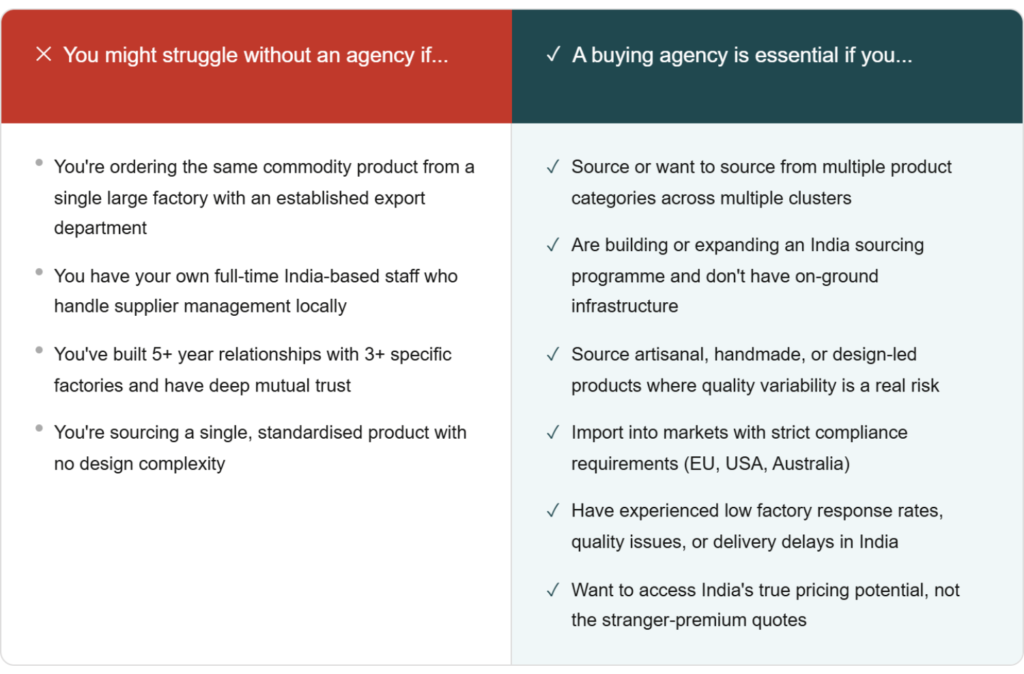
Not every buying agency is equal, and not every buyer is ready for every agency. Here are the conditions under which working with a professional India buying house will deliver maximum value:
The Commission Isn't the Price of Access. It's the Price of Everything.
When you pay a buying agency’s commission, you’re not paying for a service. You’re paying for a position – a position inside India’s manufacturing ecosystem as a known, trusted, vouched-for buyer. That position is worth infinitely more than what you pay for it.
It’s worth the best prices the market can offer, because the factory isn’t guessing what margin to protect against you. It’s worth quality that you can count on, because the factory knows the inspection is coming and their long-term relationship with the agency depends on consistently good work.
It’s worth access to every cluster in India – Moradabad’s 400-year-old brass tradition, Jaipur’s exquisite hand-block printing, Jodhpur’s award-winning furniture, Bhadohi’s world-class rug weaving – all accessible through one relationship.
And it’s worth something that no spreadsheet can fully quantify: peace of mind. Knowing that someone with decades of local knowledge, real supplier relationships, and aligned commercial incentives is on your side, in India, every day your order is in production.
India is not difficult. India is relationship-based. Understand the difference, invest in the right infrastructure, and you’ll discover what the best home decor importers in Europe and the USA already know:
India doesn’t just offer competitive prices. It offers something more valuable – products that carry stories, made by people who have perfected their craft over generations. That’s not available anywhere else. And a great buying agency is the door.
Ready to Unlock What India Can Actually Do for Your Business?
Azoonis is India’s leading buying house for home decor and handicraft imports – with offices in Ahmedabad and Moradabad, direct factory relationships across every major cluster, and a track record of building profitable, compliant, and consistently excellent India sourcing programmes for buyers across Europe, the USA, and Australia.