

Best Products to Source from India for Your Ecommerce Business in 2026-27
Table of Content
Introduction

India’s home decor and artisan products have a structural advantage in this environment. They’re visually distinctive by nature. They carry authentic cultural provenance. They photograph with texture and warmth that machine-made alternatives can’t replicate. And they’re not on every other drop-shipping catalogue.
But not all Indian categories are equally suited to ecommerce. Here’s where the real opportunity is, and what you need to know about each one before you commit.
What Makes an Indian Product Work on Ecommerce
- Visual distinctiveness: They look handmade because they are. That slight irregularity, the visible texture, the imperfect pattern – these read as premium online in a way that mass-produced items can’t fake.
- Story-ready: “Hand-hammered by artisans in Moradabad” is a product listing sentence. It adds perceived value, enables premium pricing, and connects with buyers who want to know where their products come from.
- Low SKU fragmentation: Products with multiple natural variations (colours, finishes) can be listed as single ASINs with variants, reducing your catalogue complexity.
- Reasonable weight-to-value ratio: Heavy products with low retail value struggle with ecommerce unit economics. Decorative metalware, textiles, and ceramics typically have good value density.
- Low return risk: Products where the “handmade variation” is part of the value proposition see lower return rates than mass-produced items where buyers expect uniformity.
The Categories That Perform Best for Ecommerce Sellers
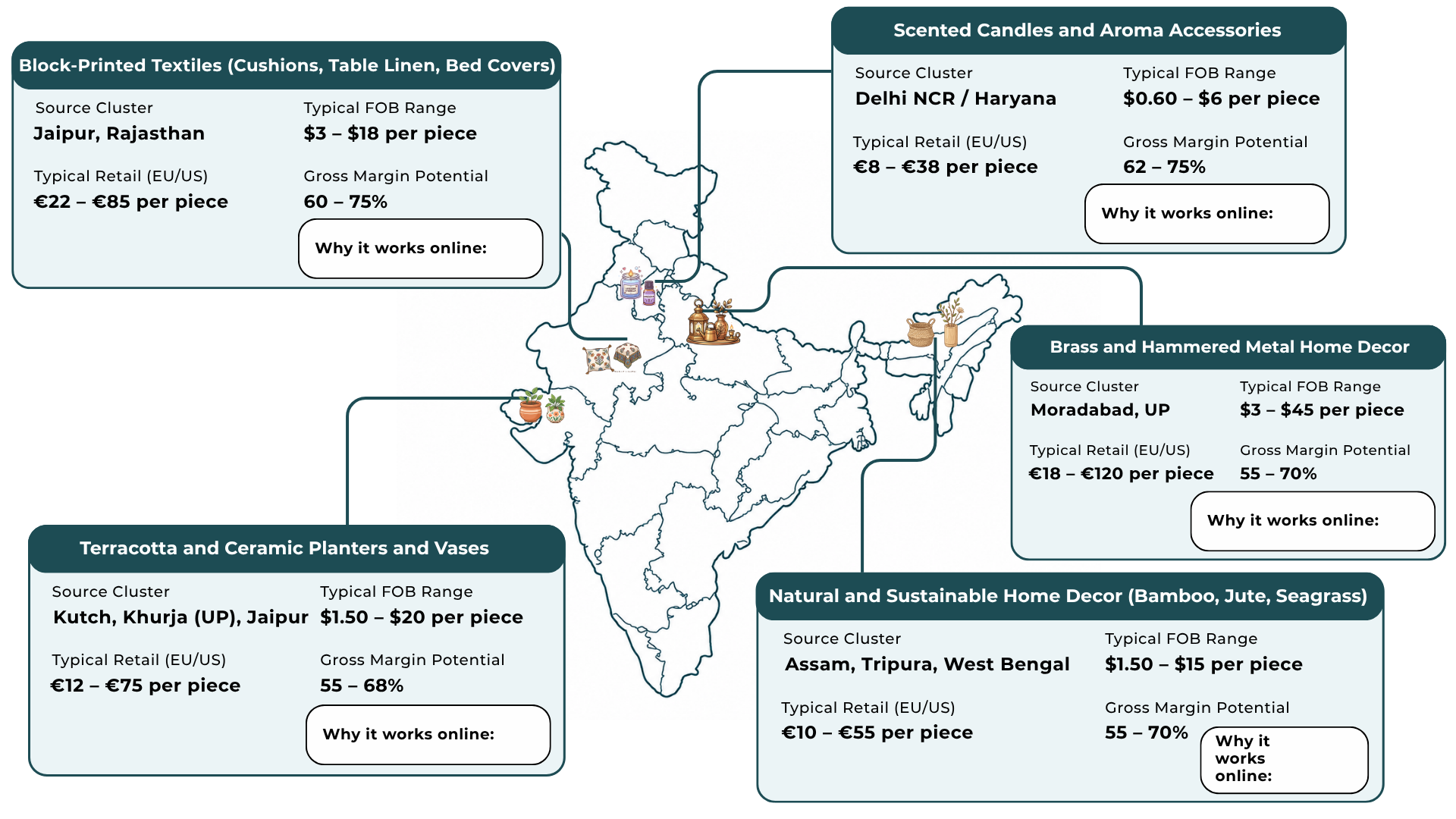
Block-print patterns are visually distinctive in thumbnail. Buyers actively search for "block print cushion cover" — this is a keyword-rich niche with real purchase intent. OEKO-TEX certified versions justify price premiums.
Consumable product with strong repeat order patterns. Subscription model fits naturally. Pairs beautifully with Indian-made vessels (brass, terracotta, glass) for bundle selling. IFRA-compliant fragrance is essential for EU market.
The biophilic and Japandi design trends have driven consistent demand growth. Handmade terracotta has visible texture that converts well. Bundle with soil, seeds, or macrame hangers for higher basket values. Important: strong packaging essential — breakage is the main risk.
"Sustainable," "natural," and "eco-friendly" are high-search, high-conversion keywords in home decor. India's bamboo and natural fibre products are genuinely sustainable — not greenwashing. Amazon's Climate Pledge Friendly badge can be earned by qualifying products, improving search visibility.
Hand-hammered texture photographs unlike anything mass-produced. Antique brass and brushed gold finishes perform exceptionally on visual platforms. "Handmade in India" adds listing credibility. Strong repeat purchase and gift buying patterns.
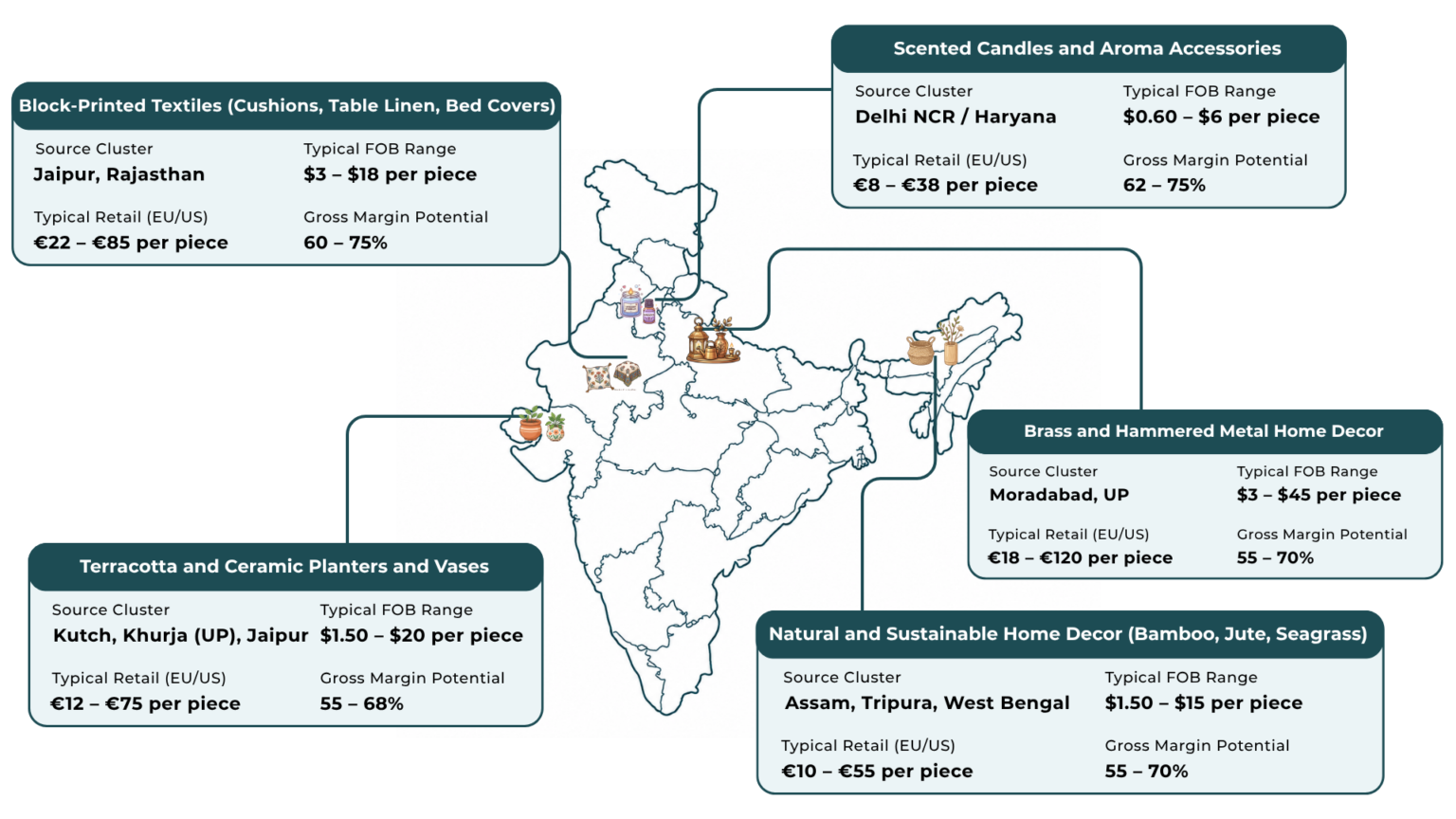
1) Block-Printed Textiles (Cushions, Table Linen, Bed Covers)
Why this works online: Block-print patterns are visually distinctive in thumbnail. Buyers actively search for “block print cushion cover” – this is a keyword-rich niche with real purchase intent. OEKO-TEX certified versions justify price premiums.
2) Scented Candles and Aroma Accessories
Why this works online: Consumable product with strong repeat order patterns. Subscription model fits naturally. Pairs beautifully with Indian-made vessels (brass, terracotta, glass) for bundle selling. IFRA-compliant fragrance is essential for EU market.
3) Brass and Hammered Metal Home Decor
Why this works online: Hand-hammered texture photographs unlike anything mass-produced. Antique brass and brushed gold finishes perform exceptionally on visual platforms. “Handmade in India” adds listing credibility. Strong repeat purchase and gift buying patterns.
4) Terracotta and Ceramic Planters and Vases
Why this works online: The biophilic and Japandi design trends have driven consistent demand growth. Handmade terracotta has visible texture that converts well. Bundle with soil, seeds, or macrame hangers for higher basket values. Important: strong packaging essential – breakage is the main risk.
5) Natural and Sustainable Home Decor (Bamboo, Jute, Seagrass)
Why this works online: “Sustainable,” “natural,” and “eco-friendly” are high-search, high-conversion keywords in home decor. India’s bamboo and natural fibre products are genuinely sustainable – not greenwashing. Amazon’s Climate Pledge Friendly badge can be earned by qualifying products, improving search visibility.
What Ecommerce Sellers Get Wrong About Indian Products
On writing product listings: The story angle works. “Hand-hammered by master artisans in Moradabad, India’s 400-year-old brass capital” converts significantly better than “Gold-coloured metal bowl.” The provenance is real – use it. Buyers on Etsy, Amazon, and direct-to-consumer platforms respond to authenticity when it’s communicated clearly.
- Expecting size and colour consistency identical to machine-made products. Handmade items have natural variation. This is a feature for buyers who understand it, and a return trigger for buyers who don’t. Set expectations clearly in your product listings. “Handmade: each piece is unique” is not a disclaimer. It’s a selling point when positioned correctly.
- Underinvesting in photography. The margin advantage of Indian artisan products is real, but it doesn’t materialise without product imagery that captures the craft character. A $30 photo session of an Indian brass piece does not do it justice. The ROI on professional product photography for these categories is extremely high.
- Sourcing without compliance verification. For EU marketplace sellers, REACH compliance for metalware and OEKO-TEX for textiles aren’t optional – Amazon and major European marketplaces increasingly require these certifications for listing. Verify before you order, not after the goods arrive.
What You Need in Place Before You Start
Ecommerce Seller’s India Sourcing Readiness Checklist
- Product specification ready (material, dimensions, finish, packaging requirements)
- Compliance requirements identified for your target marketplace and market
- Photography plan confirmed before samples arrive (shoot on approval, not after bulk delivery)
- Buying calendar aligned with lead times (45-90 days is standard in most categories)
- Sourcing partner or buying agency in place for supplier access and QC
- Packaging spec confirmed – fragile products need detailed packaging requirements in the PO
- Return rate expectations adjusted for natural variation in handmade products
A Word on Margins and Ecommerce Unit Economics
Ecommerce unit economics for Indian home decor categories are genuinely strong – but they require the right sourcing infrastructure to realise. The buyer getting real market prices from a trusted buying agency, with pre-shipment inspection included, and proper compliance documentation in place, is working in a fundamentally different cost structure than the buyer cold-emailing Indian factories and receiving inflated stranger quotes.
The landed cost difference between those two scenarios can be 20 to 35% on the same product. On a 60% target gross margin, that’s the difference between a healthy ecommerce business and one that’s perpetually squeezed.
Get the sourcing infrastructure right first. The margin follows.
Looking for India Products That Actually Work for Your Ecommerce Business?
Azoonis sources and curates products specifically for ecommerce sellers and DTC brands – with photography-ready quality standards, compliance documentation, and the supplier relationships to ensure consistent supply. Tell us what you’re building and we’ll tell you what’s possible.