

Published in: Sourcing from India
You Don’t Need Big Volumes to Start Sourcing from India
Table of Content
Introduction
Somewhere along the way, a lot of smaller buyers got the idea that India was a destination for big importers only. That the factories wouldn’t respond to modest volumes. That the minimums were too high. That the logistics were too complicated for someone ordering one container a year.
Some of this came from bad early experiences. Some from agents who only wanted large buyers. Some from factories that genuinely couldn’t work with small orders. The result is that many small buyers who could build excellent India sourcing programmes never start one.
Some of this came from bad early experiences. Some from agents who only wanted large buyers. Some from factories that genuinely couldn’t work with small orders. The result is that many small buyers who could build excellent India sourcing programmes never start one.
The MOQ Reality
Minimum order quantities in India’s artisan home decor sector are more flexible than most buyers expect – particularly when the right relationships are in place.
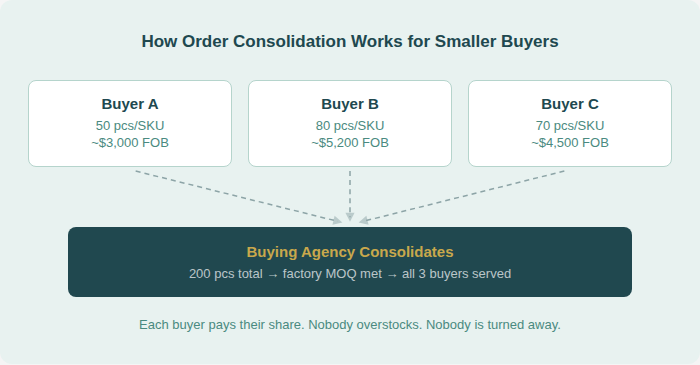
A Moradabad brass workshop producing for multiple export buyers through a buying agency can consolidate smaller orders from different buyers, allowing each to meet factory minimums without any single buyer carrying the full volume. This is something a direct buyer simply cannot access. It’s one of the structural advantages of working through an agency with an established factory programme.
A Moradabad brass workshop producing for multiple export buyers through a buying agency can consolidate smaller orders from different buyers, allowing each to meet factory minimums without any single buyer carrying the full volume. This is something a direct buyer simply cannot access. It’s one of the structural advantages of working through an agency with an established factory programme.
What "Starting Small" Actually Looks Like
A well-structured small India programme might begin with 3 to 5 SKUs across 2 product categories, at a total FOB value of $8,000 to $15,000. This is not a test order in the dismissive sense – it’s a pilot programme with a clear structure: one or two vetted factories, one QC inspection, proper documentation, and a relationship that can grow.
The buyers who build the strongest India programmes over time almost always started small. They used the first order to learn how the process works, what the communication rhythm feels like, and which factories they trust. By order three or four, they know exactly what they’re building.
The small buyer who runs one focused, well-managed pilot order in India is further ahead at the end of year one than the buyer who placed a large order without the right structure and spent the year recovering from the fallout.
The buyers who build the strongest India programmes over time almost always started small. They used the first order to learn how the process works, what the communication rhythm feels like, and which factories they trust. By order three or four, they know exactly what they’re building.
The small buyer who runs one focused, well-managed pilot order in India is further ahead at the end of year one than the buyer who placed a large order without the right structure and spent the year recovering from the fallout.
What a Buying Agency Needs From You to Work With Smaller Volumes
Minimum requirements for a workable small buyer programme:
- A clear product brief. The more specific your specifications, the more efficient the factory brief – and the less time is wasted in sampling.
- Realistic lead time expectations. 90-plus days from brief to delivery. Small orders don’t get expedited production – they need to be planned like larger ones.
- Openness to category guidance. Some categories work better at low MOQ than others. A good agency will tell you which ones.
- Intent to grow. Not a requirement, but it changes the relationship. Factories and agencies prioritise buyers who show consistent, growing engagement.
None of these require a big budget. They require preparation and patience – both of which are equally available to a $10,000-a-year buyer and a $200,000-a-year buyer.
The Mistake Small Buyers Make Most Often
Trying to source too many different products in the first order. It’s tempting to build out a full range immediately – five categories, twelve SKUs, three different clusters. The result is a complex, unmanageable first engagement where nothing gets the attention it needs.
Start focused. One or two categories. Two or three SKUs. Learn the process properly. The range expands naturally once the infrastructure is in place.
Start focused. One or two categories. Two or three SKUs. Learn the process properly. The range expands naturally once the infrastructure is in place.
India Is Accessible at Your Scale
Azoonis works with buyers at all stages – from first India order to established multi-category programmes. If you want an honest assessment of what’s possible at your current volume, start with a conversation.