AI is future of procurement
Will AI Agents Replace Sourcing Agents? What Importers Actually Need to Know
A grounded look at where AI genuinely helps physical-goods sourcing – and where it still falls short
Every few months a new wave of headlines claims AI is about to take over procurement. Most of that conversation is aimed at enterprise buyers – the kind negotiating million-dollar steel contracts or managing thousand-supplier networks with dedicated software stacks. If you’re a small or mid-size importer sourcing home goods, furniture, or lifestyle products from India, almost none of it is written with you in mind.
That doesn’t mean AI is irrelevant to you. It just shows up differently – not as a slick “autonomous negotiation agent,” but in quieter, more practical places across the sourcing process. Here’s where it’s actually useful right now, and where a human on the ground in India still does the real work.
Where AI Genuinely Helps Right Now
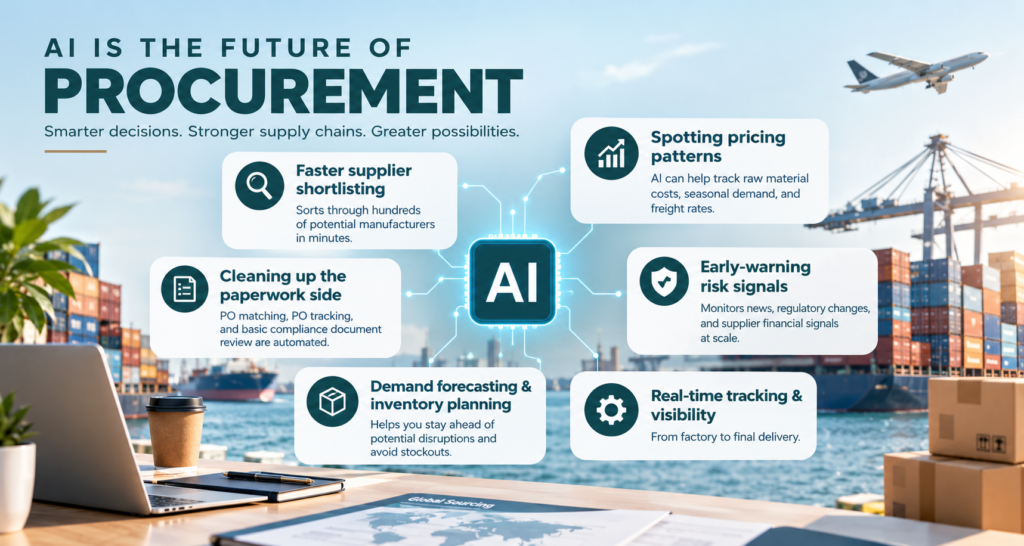
Faster supplier shortlisting
Sorting through hundreds of potential manufacturers used to mean days of manual searching across directories, trade platforms, and referrals. AI tools can now narrow that list dramatically – flagging suppliers by product category, export history, or certification status in minutes instead of days. It doesn’t replace the visit to the factory floor, but it saves a lot of dead-end searching before you get there.
Spotting pricing patterns
If you’re importing the same category repeatedly – say, ceramic tableware or wooden furniture – AI-assisted tools can help track how raw material costs, seasonal demand, and freight rates move over time. That’s useful context walking into a negotiation, even if it’s not making the final call for you.
Cleaning up the paperwork side
Invoice matching, PO tracking, and basic compliance document review are exactly the kind of repetitive tasks AI handles well. For a small importer, this mostly shows up as fewer manual errors and less time spent reconciling spreadsheets – not a transformation, but a real time saver.
Early-warning risk signals
Monitoring news, regulatory changes, and supplier financial signals at scale is something software does better than any single person scrolling headlines. It won’t tell you what to do about a looming anti-dumping duty or a port delay – but it can tell you that something’s coming before it lands on your desk as a surprise.
Where It Still Falls Short – Especially for Physical Goods
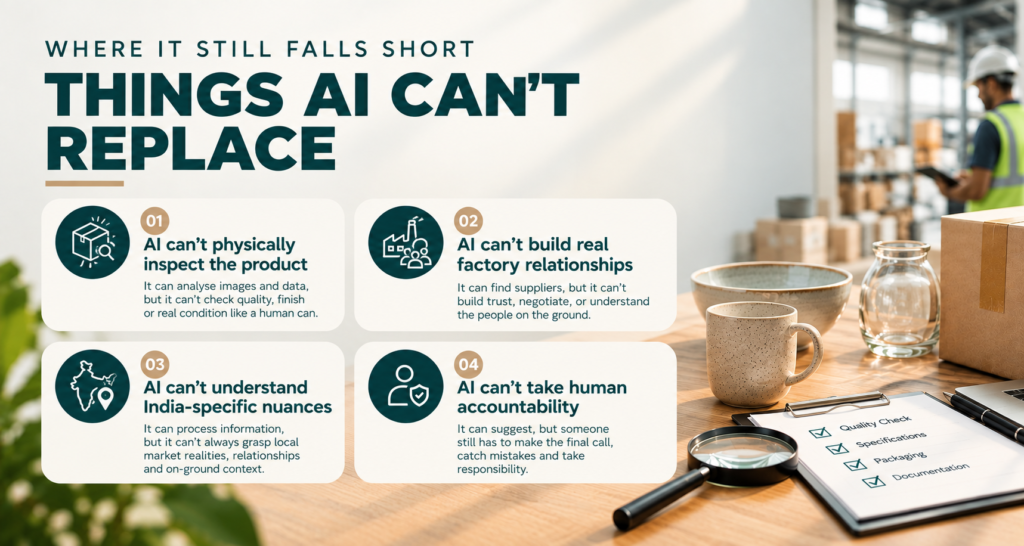
It can’t inspect a product
No algorithm can tell you whether stitching on a cushion cover will survive a wash cycle, or whether a ceramic glaze has micro-cracks that only show under the right light. Quality control for physical goods is still fundamentally a hands-on, in-person process – and it will stay that way for a long time.
It can’t read a factory relationship
A lot of what makes sourcing from India work well comes down to things that are hard to quantify: whether a supplier will prioritize your order during a busy season, whether they’ll tell you honestly about a delay instead of going silent, whether they’ll accommodate a last-minute design tweak. That’s relationship capital built over repeat orders and in-person visits – not something a chatbot can substitute for.
It can’t navigate India-specific nuance
Regional festival shutdowns, informal payment norms in certain clusters, which factories genuinely export-ready versus which just claim to be – this is local, on-the-ground knowledge that doesn’t show up cleanly in any dataset. It’s learned by being there.
It still needs someone to catch its mistakes
AI tools are only as good as the data feeding them. A supplier database that’s six months out of date, or a “verified” badge that was never properly checked, can quietly steer an AI recommendation in the wrong direction – and a buyer without local context has no easy way to catch that before it costs them.
What This Actually Means for Importers
The realistic picture isn’t “AI versus sourcing agents.” It’s AI as a filter, and people as the judgment layer that comes after. A good sourcing partner today should be using AI-assisted tools to move faster through supplier discovery and paperwork – while still putting boots on the ground for the parts that actually determine whether your shipment arrives on time, in spec, and without surprises.
If a sourcing provider tells you their AI can fully replace factory visits, sample inspections, or in-person supplier vetting, that’s worth being skeptical of. The technology genuinely helps with speed and pattern-spotting. It doesn’t yet – and may never fully – replace someone standing in a factory in Morbi or Jaipur, checking the stitching, asking the awkward question about lead times, and building the kind of trust that gets your order prioritized next season.
The Bigger Picture
AI isn’t going to make sourcing agents obsolete any time soon – but it is changing what a good one spends their time on. Less time buried in spreadsheets and directory searches, more time where it actually matters: in the factory, in the negotiation, and in the relationship that keeps your orders moving smoothly order after order.
FAQ
It can narrow down a list quickly based on category, certifications, and export history – but verifying reliability still requires an in-person visit or a trusted local partner who’s already assessed the factory.
Not necessarily. AI tools can speed up research, but the value of a sourcing agent comes from quality control, negotiation, and logistics management – none of which AI currently replaces for physical goods.
For enterprise procurement of standardized parts, AI is automating more of the process. For sourcing physical, quality-sensitive products like home goods and furniture, human inspection and relationship management remain essential.
Mainly for faster supplier shortlisting and market monitoring – the groundwork that lets our team spend more time on factory visits, sample checks, and negotiation, rather than less.
Let AI Filter. Let Us Verify.
Azoonis uses AI-assisted tools for faster supplier shortlisting and pricing pattern tracking, then puts a person on the factory floor for sample inspection and supplier vetting – so the parts no algorithm can judge still get judged by someone standing in the room.