

How to Find Reliable Manufacturers in India Without Getting Burned
Table of Content
- Introduction
- The Landscape You're Navigating to Find Supplier
- The 7-Point Supplier Verification Process That Works
- Red Flags and Green Flags: Validating the supplier fast
- The Platform Problem: Why IndiaMart Isn't Enough
- When to Use a Buying Agency for Supplier Discovery
- The Three Questions That Separate Serious Suppliers from Time-Wasters
- One More Thing: Visit Before You Scale
Introduction
Every experienced India importer has a story. Usually it starts the same way: a supplier who looked great on paper, communicated well, sent decent samples, and then delivered a production run that had nothing to do with what was approved. Or demanded additional payment before shipping. Or simply stopped responding after the advance was paid.
These stories are real. They’re also avoidable. Not by avoiding India, but by understanding what reliable looks like – and knowing the signs that something isn’t.
of Indian exporters report that identifying genuine overseas buyers is their biggest challenge. The same distrust flows both ways. Understanding it is your first advantage as a buyer.
The Landscape You're Navigating to Find Supplier
What you’ll encounter when searching for suppliers in India falls into roughly three categories:
- Genuine manufacturers who make things themselves, have proper facilities, and have a track record of export. These are who you want.
- Trading companies or brokers who present themselves as manufacturers but actually source from multiple factories and add their own margin. Not always a problem, but you should know what you’re working with.
- Opportunists who have good English, a polished website, and no real production capability. They take deposits and then scramble to fulfill orders, usually unsuccessfully.
The challenge is that these three types can look identical from an overseas inquiry. Distinguishing them requires a structured due diligence process.
The 7-Point Supplier Verification Process That Works
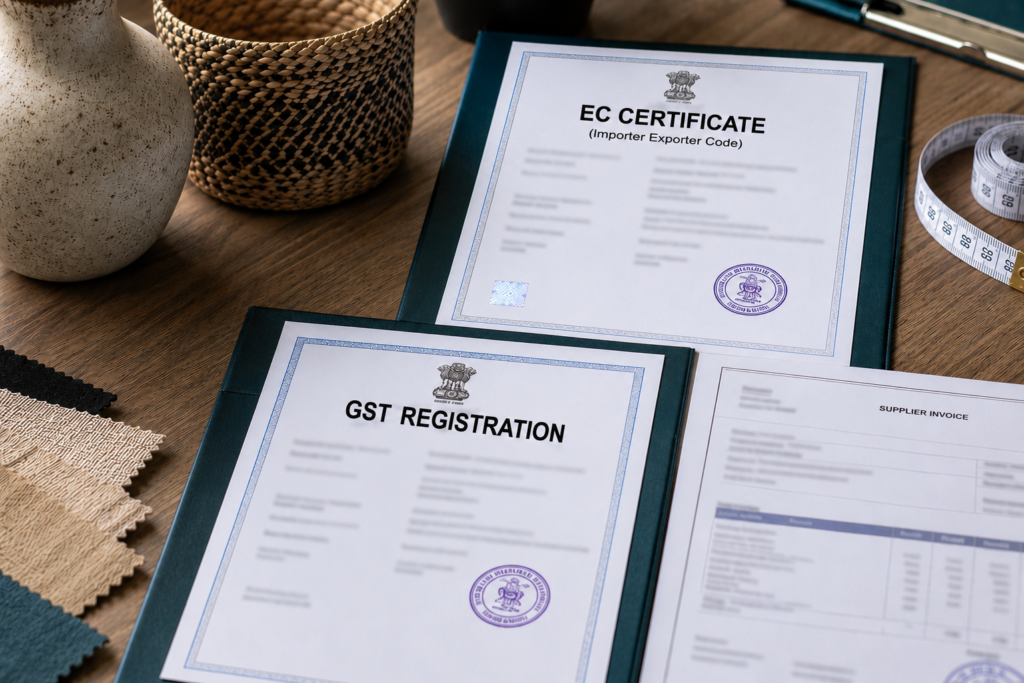
Supplier Due Diligence Checklist
– GST registration. All businesses in India with export operations must be GST registered. Ask for their GSTIN and verify at gst.gov.in. A supplier unwilling to share this is a red flag.
– Export history and shipping bill records. Legitimate exporters have a paper trail. Ask for shipping bills or airway bills from recent exports to markets similar to yours. These are not confidential documents.
– Factory visit or virtual tour. Ask for a video call where you are shown the actual production floor. Seeing machinery, workers, and WIP (work in progress) for your type of product is a basic quality check that costs nothing.
– Reference check from existing buyers. A supplier with a real export history will have international buyers who can vouch for them. Ask for two references. A refusal is information.
– Sample before any payment. Never pay for production without receiving and approving a physical sample. Couriered samples from India typically arrive in 4 to 7 days – any supplier insisting on advance payment before a sample is a warning sign.
– Production capacity check. Ask directly: “How many units of this product can you produce per month?” Follow up with: “What is your current production backlog?” A factory that can’t answer these questions doesn’t have control of their production.
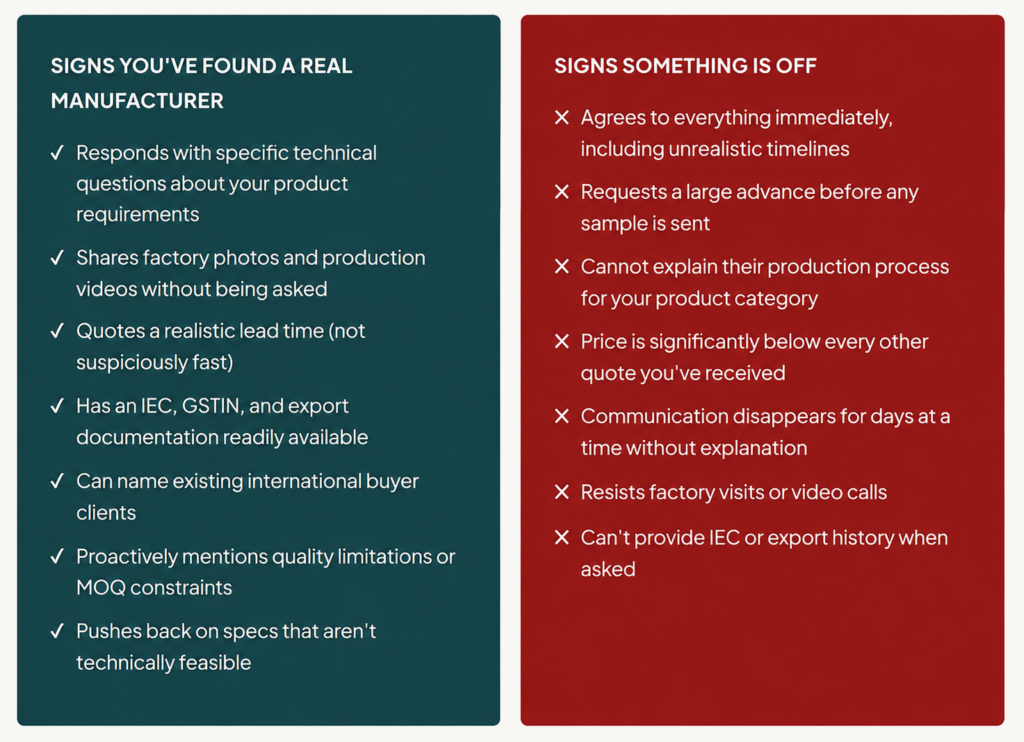
Red Flags and Green Flags: Validating the supplier fast
The Platform Problem: Why IndiaMart Isn't Enough
IndiaMart lists over millions of businesses. Alibaba’s India section has millions more. These platforms are excellent for initial research – understanding what’s available, getting a sense of price ranges, identifying categories. They’re not a reliable substitute for proper verification.
The most significant gap on both platforms: they don’t distinguish between manufacturers and traders. A company that buys from factories and resells to you can list as a “manufacturer” on both platforms without any verification. This doesn’t make them dishonest, but it does mean your due diligence can’t stop at platform listings.
Note on IndiaMart specifically: The platform caters primarily to India’s domestic market. Many suppliers listed there don’t have export experience and may not understand international compliance requirements, documentation, or quality standards. Always confirm export history before proceeding with any IndiaMart-sourced supplier.
When to Use a Buying Agency for Supplier Discovery
The most efficient route to a verified, reliable Indian manufacturer, especially in home decor, is through a professional buying agency with established relationships in the relevant manufacturing cluster.
This isn’t about outsourcing your thinking. It’s about recognising that trust in India’s manufacturing ecosystem is built over years of ongoing business. A buying agency that has been working with a Moradabad brass factory for five years, placing regular orders across multiple clients, already has the kind of relationship that takes you 3 to 5 years to build independently.
You get immediate access to that trust. The factory knows the agency. They won’t overquote, won’t under-deliver, and won’t disappear. The relationship itself is the quality assurance infrastructure.

The Three Questions That Separate Serious Suppliers from Time-Wasters
Before you invest real time in a supplier relationship, ask these three questions in your first substantive communication:
- “What markets do you currently export to, and what volume?” A genuine exporter can answer this specifically. A non-exporter can’t.
- “What is your production capacity for this product in a standard month?” Reveals whether they actually make the product or source it from elsewhere.
- “What certifications do you hold, and what testing do your products currently pass?” An export-ready manufacturer in your target product category should understand basic compliance requirements for major markets.
The answers won’t guarantee a perfect supplier. But they’ll quickly filter out the ones who aren’t ready for a serious export relationship.
One More Thing: Visit Before You Scale
If you’re planning to build a meaningful India sourcing programme, visit your key suppliers in person before you scale up. Once a year at minimum. A 4-day factory trip to Moradabad or Jaipur will show you more about your suppliers’ real capability and culture than 12 months of email exchange.
It also signals something important to the factory: that you’re a real buyer, that you care, and that you’re investing in the relationship. In India’s relationship-based manufacturing ecosystem, that signal changes everything about how you’re treated.
Looking for Verified Suppliers in India?
Azoonis maintains vetted supplier relationships across India’s key home decor manufacturing clusters. We handle supplier discovery, due diligence, and the entire sourcing relationship on your behalf. No cold emails, no guesswork, no wasted time.