


India Has a Production Calendar. Most Buyers Ignore It.
Table of Content
Introduction
Most India sourcing problems aren’t quality problems or supplier problems. They are calendar problems. A buyer who places a Christmas order in September and expects delivery in November has not accounted for how India’s production calendar actually works. The frustration that follows feels like India failed them. It was the plan that failed.
Understanding India’s seasonal rhythm is one of the simplest and highest-return things any buyer can do.
The Two Things That Drive India's Production Calendar
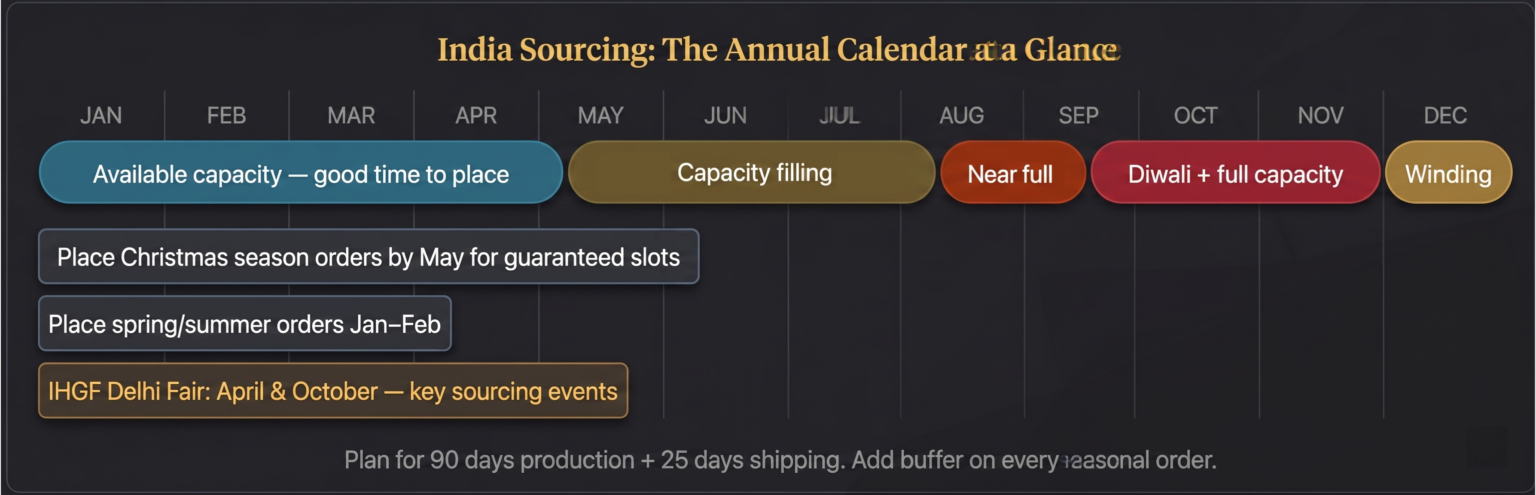
First: artisan capacity is finite. India’s home decor manufacturing is not a factory switch that scales up on demand. The craftspeople are skilled individuals, often in family workshops. When global demand peaks before the holiday season, the same pool of artisans is being asked to produce more by every buyer at once. Something gives, and it is usually the buyer with the least leverage or the most recent order.
Second: India has its own festive season. October and November bring Diwali, one of India’s most significant national celebrations. Many artisan workshops reduce output or close for parts of this period. This is the same months that European and US buyers most urgently need goods delivered.
The Rule That Experienced Buyers Use While Planning the Production
Plan 90 days of production plus 25 days of ocean freight, then add a 2-week buffer. For Christmas delivery, that means production orders placed no later than early May. For a Spring launch, orders need to go in by November.
This sounds like a lot of lead time. It is. It is also the reality of artisan manufacturing. The buyers who work within this reality consistently get what they ordered, when they need it. The buyers who push against it are the ones who pay for air freight in December.
We tell every new buyer the same thing: your India calendar is not the same as your China calendar. It cannot be. The sooner that is built into your buying process, the better every subsequent order becomes.
One More Thing Most Buyers Miss in Production Planning
The monsoon season, roughly July through September, affects certain natural material categories. Bamboo, jute, and natural fibre products face higher moisture exposure risk during production and shipping in this period. This is manageable with the right packaging specs and production planning, but it requires awareness. An experienced buying agency accounts for this automatically.
Build a Calendar That Actually Works
Azoonis helps buyers build buying calendars that account for India’s production rhythm, festive season capacity, and seasonal material considerations. The result is fewer surprises and better delivery performance across the year.