Beyond the Price Tag: The Real ROI Playbook for Brands Sourcing from India
Table of Content
Key Takeaways
- Real ROI in sourcing has less to do with the cheapest quote and more to do with total cost, reliability, and how fast product reaches the shelf.
- A sourcing approach built around total cost of ownership (TCO) holds up even when freight or raw material prices move unexpectedly.
- India’s manufacturing landscape gives buyers deep category depth – from home decor to industrial parts – without leaning on a single country for everything.
- On-ground quality checks and durable vendor relationships stop the “cheap today, costly tomorrow” cycle of rejected containers and rework.
- Clean paperwork around Incoterms and payment terms protects more margin than most buyers give it credit for.
- The right sourcing KPIs turn procurement from a cost line into an actual growth driver.
For brands buying internationally, India has moved past being a backup option and become a genuine pillar of supply chain planning. But simply having access to manufacturers doesn’t hand you ROI on its own – that comes down to how the relationship is set up, run, and measured. Here’s what actually makes the difference.

What Actually Drives ROI When Sourcing From India
1. Define the Outcome Before You Ask for a Quote
Smart buyers decide upfront what they’re solving for – landed cost, faster lead times, MOQ flexibility, or having more than one supplier to fall back on. Starting with a clear brief keeps you from chasing the lowest number and ending up with someone else’s quality headache.2. Unit Price Is Only One Line on the TCO Sheet
A supplier’s quoted price rarely tells the whole story. Freight, duties, inspection, rework, and the working capital locked up in longer payment terms all sit beneath it. Buyers who look at total cost of ownership rather than sticker price consistently make sounder calls – even if that means paying slightly more for a factory that won’t let them down.3. Lean on Cluster Expertise, Not Just One Factory
India’s manufacturing strength is built around regional clusters – brass goods from Moradabad, ceramics from Khurja, textiles from Tiruppur, leather from Kanpur. A sourcing partner who knows these clusters opens the door to vetted, specialized manufacturers instead of the limited range one factory can offer.4. Shortlist Vendors Using Data, Not First Impressions
Spend history, past rejection rates, on-time delivery records, and factory audit scores should decide who makes your shortlist – not a sample that photographed well. Even a basic scorecard system flags a weak vendor months before a shipment goes sideways.5. Treat Supplier Relationships as Long-Term Infrastructure
A factory that already understands your quality bar, packaging requirements, and seasonal spikes is worth more than a new vendor quoting 3% cheaper. Long-standing supplier relationships buy you priority production slots, more flexible MOQs, and far fewer surprises during peak season.6. Diversify Before Circumstances Force Your Hand
The past few years have shown exactly what happens when a supply chain depends on one country or one factory. Buyers who add India as part of a “China plus one” or a fully diversified base build resilience in ahead of time – instead of scrambling after a disruption hits.7. Nail Incoterms and Payment Terms From Day One
Fuzzy Incoterms (who’s responsible for the goods and risk, and from what point) along with loosely written payment terms are two of the quietest ways margin leaks out of an import order. Getting the documentation right upfront heads off expensive disputes and demurrage later.8. Bake Quality Control Into the Process, Not the Cleanup
Pre-shipment inspections and in-line checks cost a fraction of what a rejected container or a wave of returns costs. Buyers who budget for inspection as a standard line item – not an afterthought – protect both margin and brand name.9. Let Technology Close the Guesswork Gaps
Between digital sampling, video factory audits, and shipment-tracking dashboards, sourcing today has far fewer blind spots than it did five years back. Buyers using these tools cut down on communication lag and avoid costly cross-timezone misunderstandings.10. Consolidate Shipments Where It Makes Sense
Merging smaller orders across categories or vendors into one consolidated shipment brings down per-unit freight and simplifies customs – particularly useful for D2C and boutique retail brands still growing their order volumes.11. Don’t Treat Compliance and Sustainability as Optional
Environmental and labor compliance has gone from a checkbox exercise to something many international retailers and marketplaces now require proof of. Weaving this into vendor selection early avoids last-minute scrambles right before a shipment is due to leave port.12. Measure What Actually Reflects Sourcing Health
Cost savings alone can be a misleading number. Buyers who also track on-time delivery rate, defect and rejection rate, lead-time variance, and landed cost per unit get a far more honest read on whether their sourcing strategy is actually working.Where the ROI Actually Shows Up
| Focus Area | What to Do | Effect on ROI | Business Payoff |
|---|---|---|---|
| Total Cost Thinking | Evaluate landed cost, not just unit price | Prevents hidden margin leaks | Healthier true margins |
| Cluster Sourcing | Work with region-specialized manufacturers | Better quality-to-price fit | Fewer rejections, better fit-for-purpose goods |
| Vendor Scorecards | Rate suppliers on data, not first impressions | Reduces vendor risk | More predictable output |
| Supplier Partnerships | Invest in long-term factory relationships | Priority capacity, flexible MOQs | Smoother peak-season scaling |
| Diversification | Avoid single-country/single-factory dependency | Fewer disruption shocks | Continuity of supply |
| Documentation Discipline | Lock down Incoterms & payment terms early | Avoids disputes & demurrage | Predictable landed costs |
| Quality Control | Build in pre-shipment inspection | Cuts rework and return costs | Protects brand reputation |
| Digital Tools | Use tracking, video audits, dashboards | Faster issue detection | Fewer costly surprises |
| Consolidation | Combine shipments where possible | Lower per-unit freight | Better economics for smaller brands |
| KPI Tracking | Monitor delivery, defect & lead-time metrics | Continuous course correction | Sourcing becomes measurable |
India’s Export Numbers Back Up the Shift
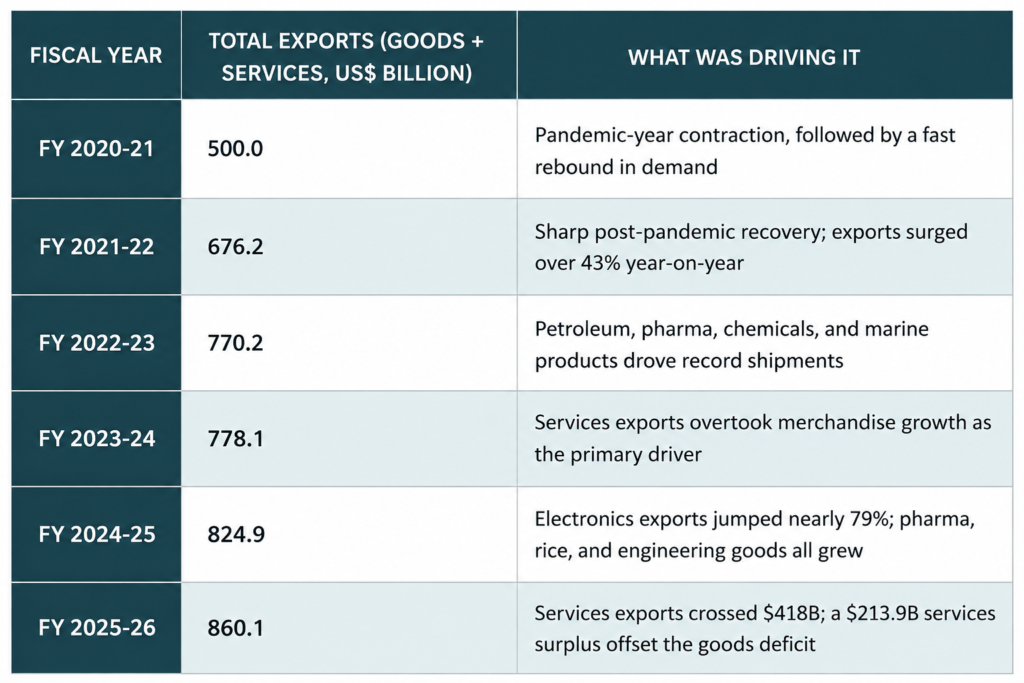
Buyers don’t move into a sourcing market because it feels right – they follow the capacity and momentum that’s actually there. And the export data explains why India keeps surfacing in “where do we source from next” conversations.
Source: Ministry of Commerce and Industry / Press Information Bureau, India
What the Numbers Tell Us
India’s combined exports have climbed roughly 72% over five fiscal years – from $500 billion in FY 2020-21 to $860 billion in FY 2025-26 – a trend line that’s hard for long-term sourcing buyers to ignore.
Growth also isn’t concentrated in one category. In the most recent full-data year, electronics exports climbed close to 79%, rice rose about 45%, pharmaceuticals grew over 21%, and gems & jewellery increased roughly 16% – the kind of spread that tells international buyers there’s real manufacturing depth behind the pitch, not just a low-cost story.
For brands already sourcing from India – or weighing it against other markets – this steady climb is less about riding a trend and more about backing a supply base that’s scaling in exactly the categories that matter.
Azoonis International helps global buyers source confidently from India
from supplier vetting and quality checks to Incoterms and logistics – so ROI shows up in the numbers, not just the quote.